Research
Inside the engines
Three studies of how chess engines think and how they are built: what a neural network really thinks a piece is worth, whether an engine was written by a human or generated by AI, and how alike the strongest engines in the world have become.
What is a chess piece really worth?
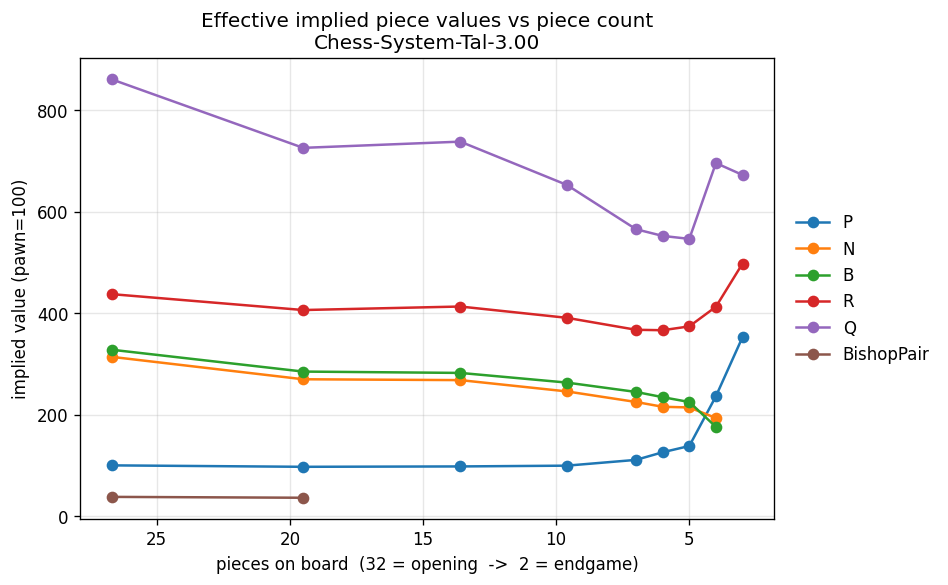
Chess System Tal 3 judges positions with a neural network that holds no piece-value table at all — so we reverse-engineered one. By regressing millions of the engine's own evaluations we recovered what each piece is truly worth to it, how those values slide from a crowded opening to a bare endgame, and the piece-square maps it taught itself with nothing hand-coded: knights that crave outposts, a king that flips from cowering in the corner to marching up the board, and a queen worth nearly nine pawns when there's a full board to attack.
Chess engine forensics
A companion project: a forensic read of chess-engine source code, judging each repository on two axes — was it written by a human or generated by AI, and how close does it sit to Stockfish? Every engine is cloned, its git history and code scanned for the tell-tale fingerprints, then contrasted with Stockfish.
So far, more than fifty engines. Eighteen newly-released ones get full individual write-ups — among them three that proved AI-generated, spanning the full quality range: one a careless paste that still had the AI's own citation markers left in the comments; one assembled in a single agent run; and one — Coda — where an expert directed an AI agent to write every line across thousands of SPRT-tested commits, producing a genuinely strong engine. Several more are openly AI-assisted. On top of that, a clone-and-scan sweep of the entire CCRL 40/40 top 50 — the strongest engines in the world. The verdict from that elite tier is a story in itself: no AI-generated engines, exactly one quietly AI-assisted (Arasan, human since 1994), and not a single actual Stockfish fork — they have all simply converged, independently, on the same winning design.
Was this chess engine written by a human — or generated by AI?
Forensic source reads across 14 engines — from a repo with leftover AI citation markers, through an agent-built one, to expert human projects — each placed on an authorship spectrum from AI-generated, through AI-assisted, to fully hand-written.
Read the authorship analysis →Similarity to Stockfish
A second, neutral spectrum: how close is each engine to Stockfish? From independent designs — their own board representation, hand-crafted evaluation, unusual languages — through to engines built directly on Stockfish's own search and network.
See the Stockfish-similarity spectrum →The CCRL Top 50, read for AI vs human
The same tests run across the strongest engines in the world. The result: no AI-generated engines, a near-total convergence on the Stockfish recipe — and one surprise: Arasan, human since 1994, now AI-assisted.
See the CCRL Top 50 survey →Behind the scenes: the full project write-up & methodology →
How similar are the top engines, really?
Every engine developer already knows the top of the rating list looks alike — we all read each other's work on GitHub. What nobody had was a metric. And no author can produce one honestly about their own code: you cannot audit your own influences from the inside. So I handed the job to an LLM that has no stake in the answer.
The ten strongest open-source engines on CCRL 40/15, plus Chess System Tal 2, compared pairwise across four languages — C, C++, Rust and Zig. Every statement is parsed to a syntax tree and canonicalised until a Rust line and a C++ line become comparable, with tuned constants, weights and variable names erased. Then the same eleven engines are scored against a 52-technique checklist, with cited evidence for each of 572 judgements.
The two answers point in opposite directions. At most 14% of search code is shared between any two engines — measured against a ceiling of 55%, which is what Stockfish scores against its own code from a year ago. Yet 37 of 52 techniques are present in every single engine, and no pair shares fewer than 78% of ideas. The strongest engines in the world have converged on one search and written it eleven times from scratch. Chess System Tal 2 is the outlier on both axes — and the only engine in the study still extending on checks.
Ten engines, one search
Pairwise code-overlap and idea-overlap matrices across eleven engines and four languages; the calibration control that makes the numbers readable; a 52-technique audit; the clean generational split over killers and countermove — half the top ten have deleted both — and where Chess System Tal 2 lands against the field.
Read the similarity study →