Engine Piece-Value Profiler · a study
What is a chess piece really worth?
Every chess player grows up with the same little table:
pawn = 1 · knight = 3 · bishop = 3 · rook = 5 · queen = 9
It's a wonderful guide. It's also a polite fiction. A knight is not always three pawns; a passed pawn on the seventh rank is worth far more than the one still asleep on its starting square; two bishops are quietly worth more than the sum of their parts. Every strong player feels this — but feelings are hard to put on a website.
Modern engines feel it too. The catch is that today's top engines evaluate positions with a neural network, and that network has no piece-value table inside it at all. Ask it "what's a rook worth?" and there is simply no number to read out. It just knows, the way a grandmaster knows.
So we asked it the long way round. We showed a chess engine millions of real positions, watched how its judgement moved as material changed, and worked backwards to the question it can't answer directly: what is each piece actually worth to you — and how does that change as the game goes on?
We profile one engine at a time; each gets its own section below.
Reverse Engineering a NNUE
No deep tech needed to enjoy the results, but here's the idea in a paragraph.
When an engine analyses a position, the score it reports is really its opinion of the
quiet position at the end of the line it's calculating. Collect millions of
those position → score pairs across every stage of the game — bustling
openings, tense middlegames, bare-bones endgames — and you can do some honest
bookkeeping: hold everything else equal and ask "how much does the score move when one
side has an extra knight? an extra rook? a pawn one square further advanced?" The
answer to each of those questions is that piece's implied value.
The tool that does this bookkeeping is called linear regression — the same "line of best fit" idea you may remember from school, just with more than one ingredient at a time. Picture every position as a single row in an enormous spreadsheet: one column counts each side's extra pawns, another the extra knights, the bishop pair, and so on, with the engine's score in the final column. Regression then hunts for the one set of piece values that, plugged in, comes closest to reproducing the engine's score across all the positions at once — the values that leave the smallest total disagreement (statisticians call it least squares). Those best-fit values are exactly the engine's implied price list. Because every position is weighed against every other, lucky one-offs wash out and the steady signal — what a knight is really worth to this engine — rises to the top.
One refinement matters: a neural-network engine doesn't value a piece the same in the opening as in a king-and-pawn ending, so a single fit across the whole game would blur those together. Instead we run the regression separately for each stage of the game (sliced by how many pieces remain), which is why the results come out as curves that move from opening to endgame. Finally, we line everything up with the pawn set to 1, so it all reads in familiar "pawn units."
Two things worth knowing as you read the numbers:
- These are averages over real games, not verdicts about any single position.
- They're marginal values anchored to the pawn, so don't be startled if a rook doesn't come out at exactly 5. What matters is the ladder (pawn < knight ≈ bishop < rook < queen) and how the engine spaces the rungs and slides them around as the board empties.
Chess System Tal 3
The attacking engine named for the great Mikhail Tal — profiled here with its ep285 neural net, over 4.9 million positions.
What the pieces are worth
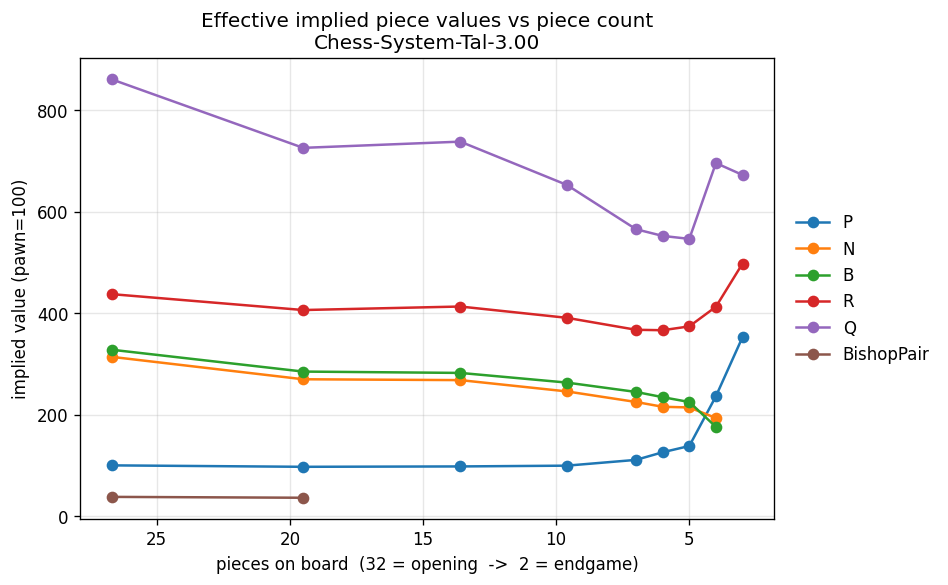
| Piece | Value (pawns) | Notes |
|---|---|---|
| Pawn | 1.00 | our yardstick |
| Knight | ~2.7 | climbs toward ~3.1 on a full board |
| Bishop | ~2.85 | noses ahead of the knight throughout |
| Bishop pair | +0.37 | a real, measurable bonus for holding both bishops |
| Rook | ~4.1 | clearly above the minors |
| Queen | ~7.3 | and soaring to ~8.6 on a full board — almost the storybook 9 |
The classic ladder P < N ≈ B < R < Q falls straight out, and Tal prices the heavy pieces richly — a queen worth nearly nine pawns with a crowded board to attack. Values are at their highest on a full board and ease as pieces come off: this engine is at its most dangerous when there's plenty of material to throw at the enemy king.
Where the pieces want to stand
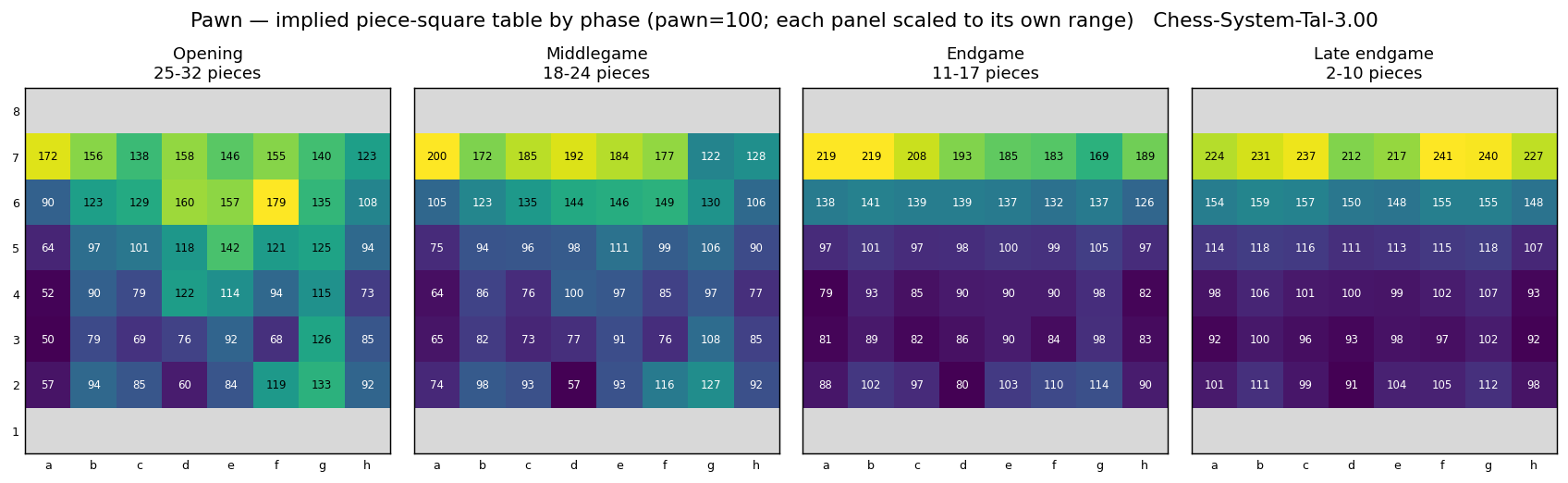
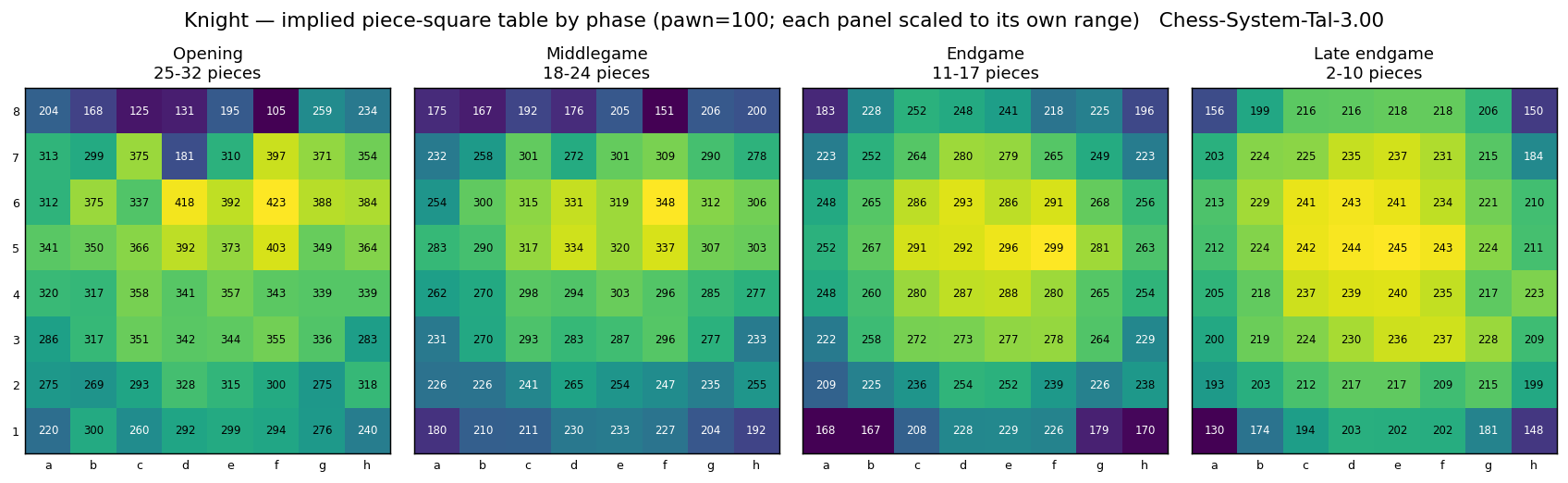
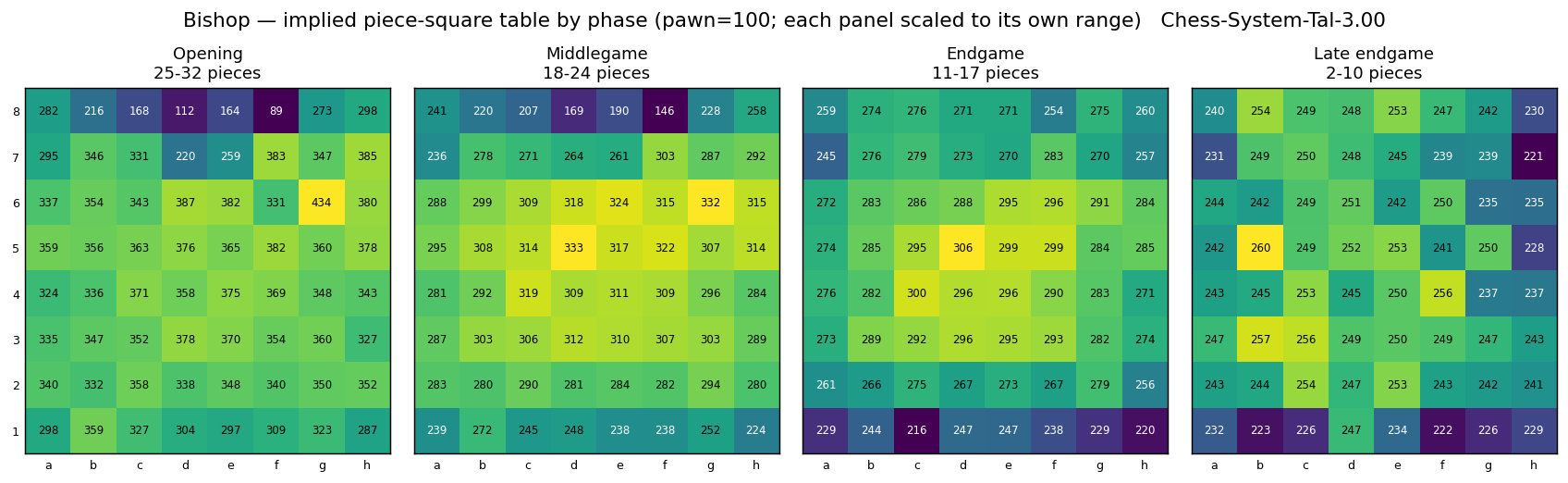
For each piece we can draw the engine's mental piece-square table — its felt value on every square — and split it across four stages of the game. (The king is special: both sides always have exactly one, so its material is constant and its map is purely positional — king safety vs. activity.)
Tip: click any board to open it full-size in a new tab for a closer look.
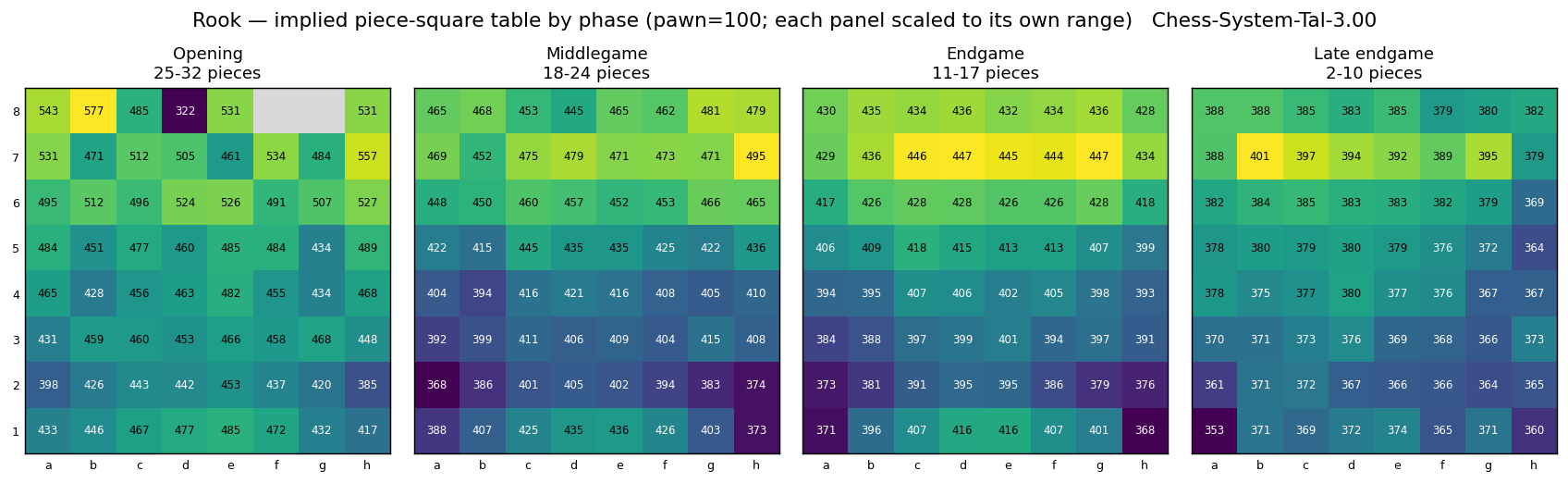
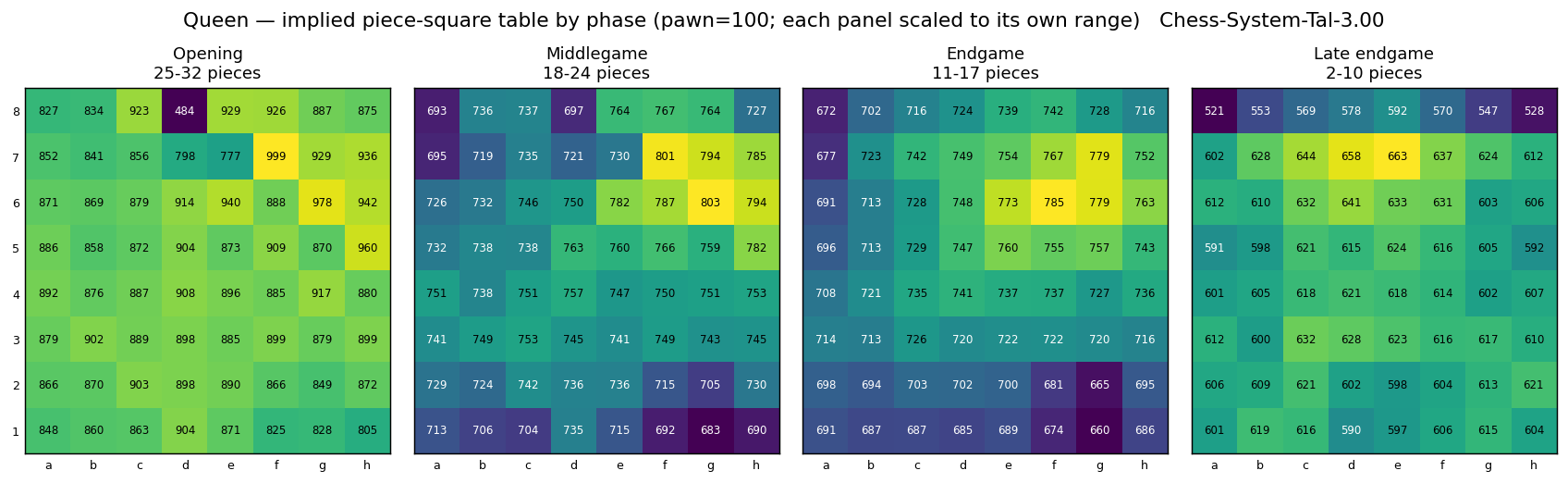
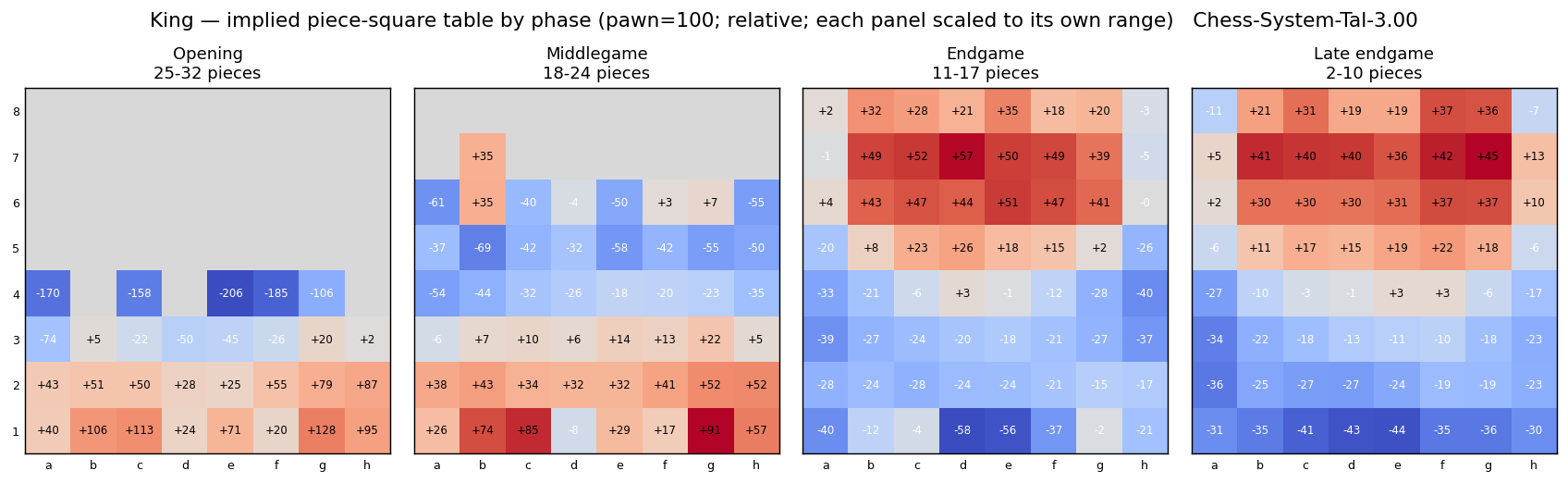
Reading them:
- Knight — loves the centre and advanced outposts (brightest around d5–f6), dies on the rim — and the whole map cools and flattens as the board empties: a knight is most precious when there's a crowded board to dominate.
- Bishop — prefers advanced central posts but a flatter map than the knight; a long-range piece cares less exactly where it sits.
- Rook — the 7th rank lights up, plus open central files; the classic "pig on the 7th."
- Queen — fairly flat, but a clear attacking hot-zone advanced on the kingside.
- King — the headline reversal: tucked safe on the castled corners in the opening/middlegame (centre is catastrophic), then flipping to march up and centralise in the endgame while the back rank turns toxic. The textbook king-safety-to-activity arc, recovered with zero hand-coding.
Each panel is colour-scaled to its own range, so the pattern shows at full contrast; the exact value is printed in every cell.
Pawns
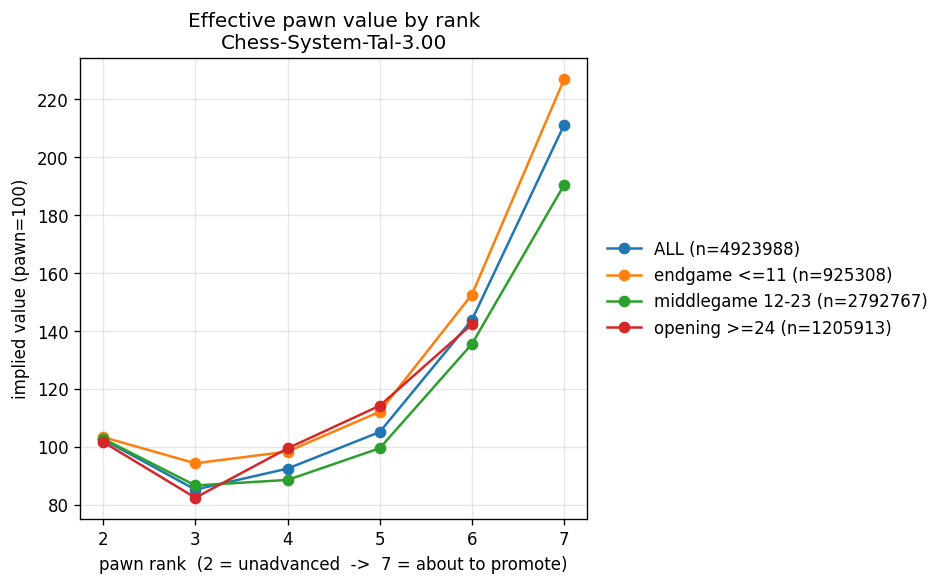
A pawn is not a pawn is not a pawn. Tracked by the rank it stands on, its value climbs from ~1.0 at home to ~2.1 on the 7th — and ~2.3 in the endgame, with a protected runner on the brink of promotion worth several pawns. The engine rediscovered that passed pawns must be pushed.
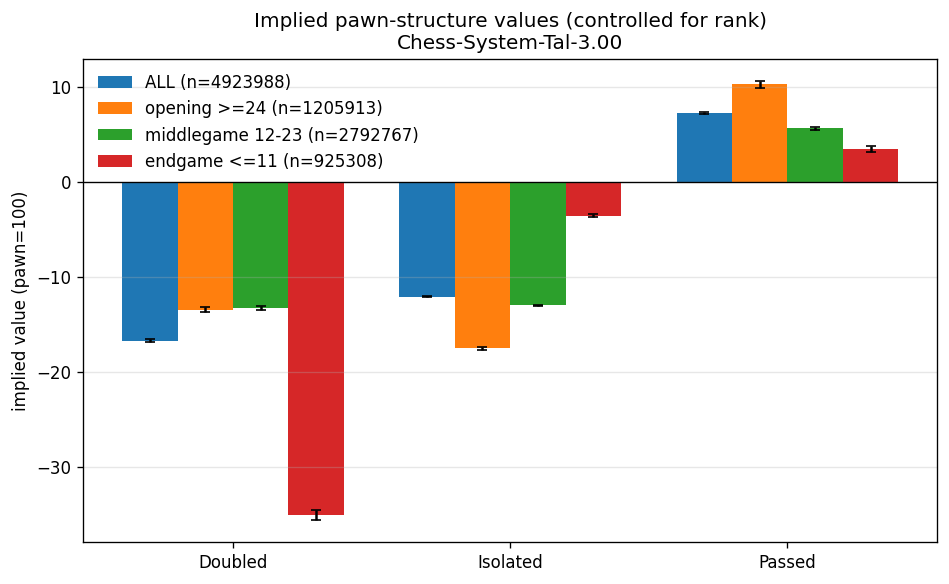
And the structure rules every club player is taught fall out too: doubled −0.17 (ballooning to −0.35 in the endgame, when crippled pawns can't be defended by activity), isolated −0.12, passed +0.07. Bad pawns are penalised, good pawns prized — no rule was ever programmed in.
Why only +0.07 for a passed pawn? This is the passer's marginal value — the extra worth of being unopposed, on top of what its rank already earns. Most of a passed pawn's strength is already counted in the rank curve above (the climb toward ~2.3 on the 7th in the endgame), and this bonus rises as the pieces come off. So +0.07 means "a fraction of a pawn more than a same-rank non-passer," not "a passer is barely worth anything."
Positional instincts
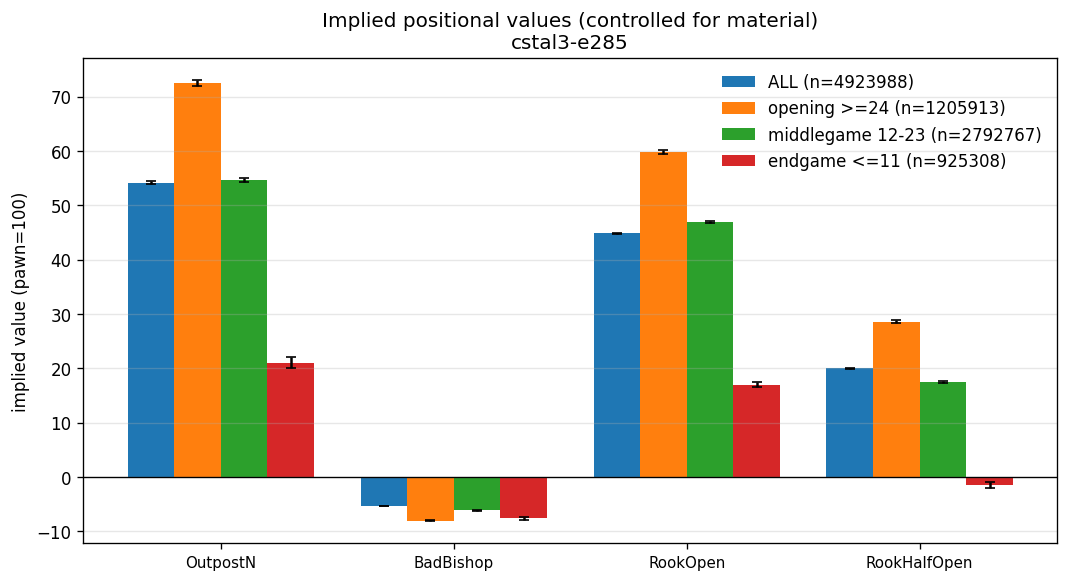
Finally, three classic judgements every strong player makes (pawn units):
| Term | All | Opening | Endgame |
|---|---|---|---|
| Knight outpost | +0.54 | +0.72 | +0.21 |
| Bad bishop (per own-colour pawn) | −0.05 | −0.08 | −0.08 |
| Rook on an open file | +0.45 | +0.60 | +0.17 |
| Rook on a half-open file | +0.20 | +0.29 | ~0 |
An outpost knight is worth up to ~¾ of a pawn in the opening; a rook on an open file nearly as much; a bishop hemmed in by its own pawns quietly leaks value. All peak with a full board and fade toward the endgame — exactly the intuition, now with numbers attached.
Stockfish 18
The reigning world number one — the cold calculator. Profiled over 5.0 million positions.
What the pieces are worth
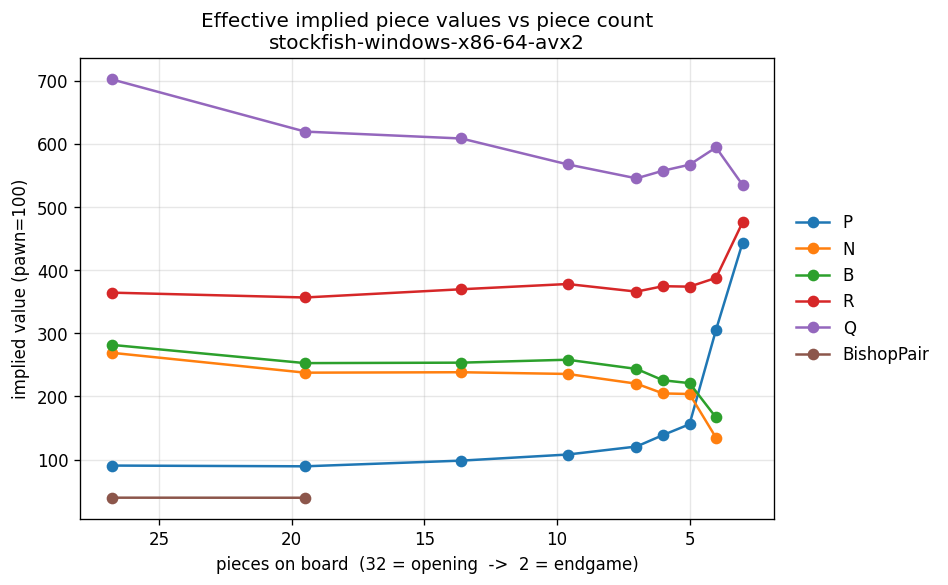
| Piece | Value (pawns) | Notes |
|---|---|---|
| Pawn | 1.00 | our yardstick |
| Knight | ~2.4 | climbs toward ~2.7 on a full board |
| Bishop | ~2.5 | noses ahead of the knight throughout |
| Bishop pair | +0.40 | a real, measurable bonus for holding both bishops |
| Rook | ~3.6 | clearly above the minors |
| Queen | ~6.2 | rising to ~7.0 on a full board |
The classic ladder P < N ≈ B < R < Q falls straight out. Stockfish is the pawn-respecting valuer: it spaces the heavy pieces more conservatively than the storybook 3/3/5/9 — a queen worth about six pawns, rooks ~3.6, the two minors a hair apart with the bishop ahead and a clean +0.4 for the pair. As always the values run highest on a crowded board and ease as pieces come off.
Where the pieces want to stand
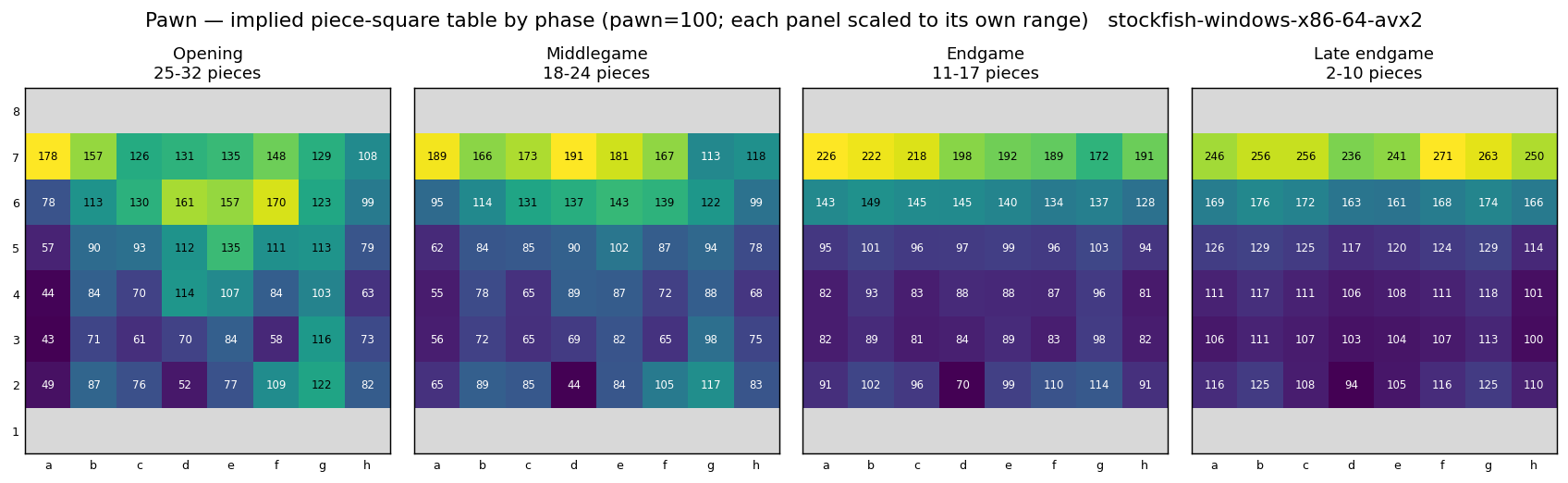
For each piece we can draw the engine's mental piece-square table — its felt value on every square — split across four stages of the game. (The king is special: both sides always have exactly one, so its material is constant and its map is purely positional — king safety vs. activity.)
Tip: click any board to open it full-size in a new tab for a closer look.
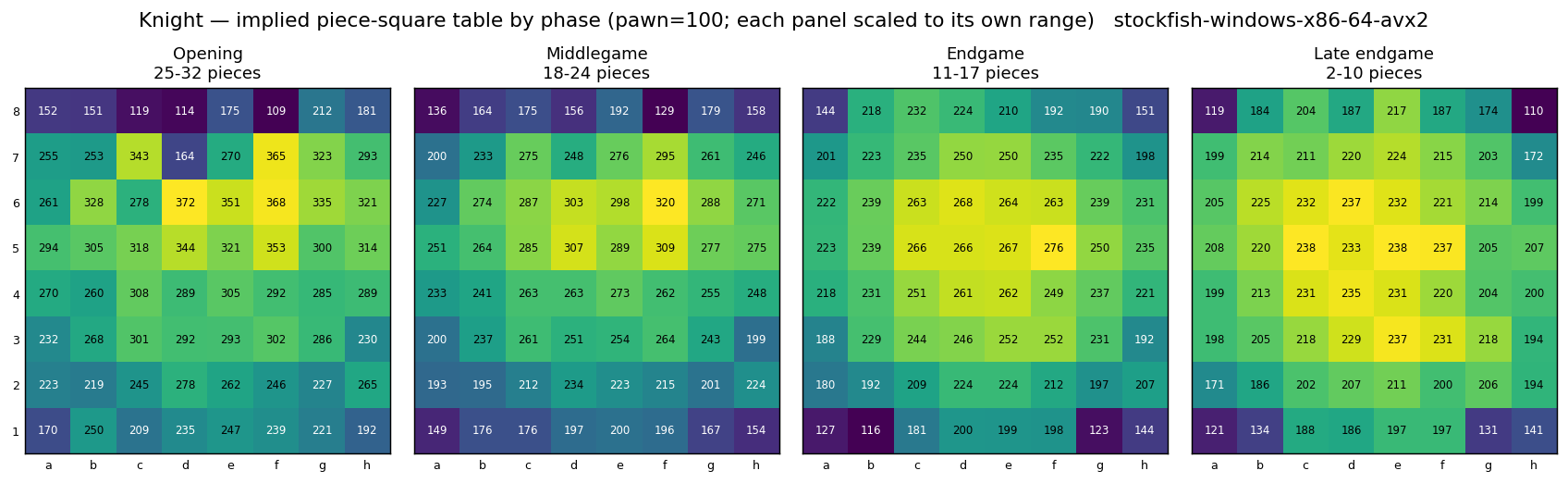
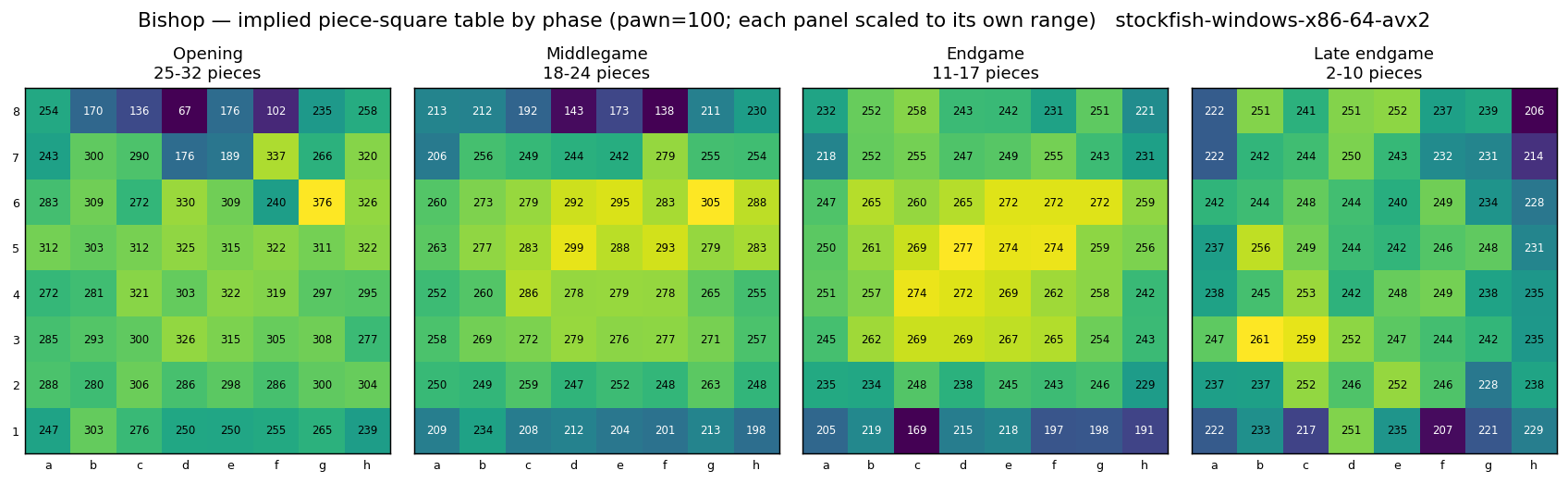
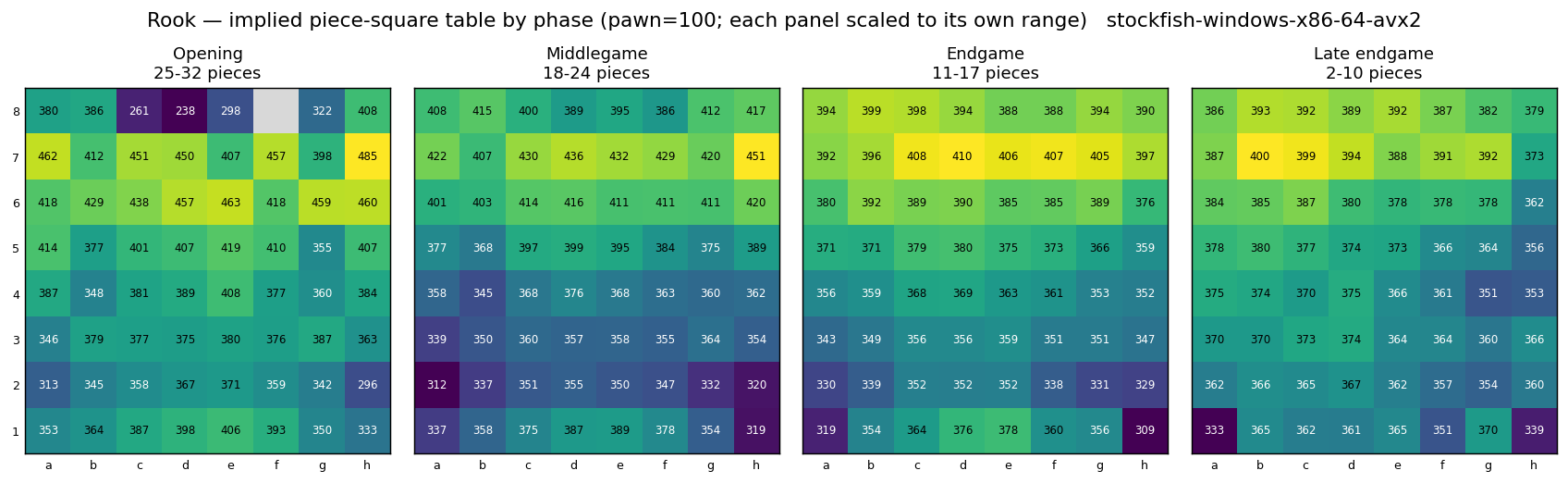
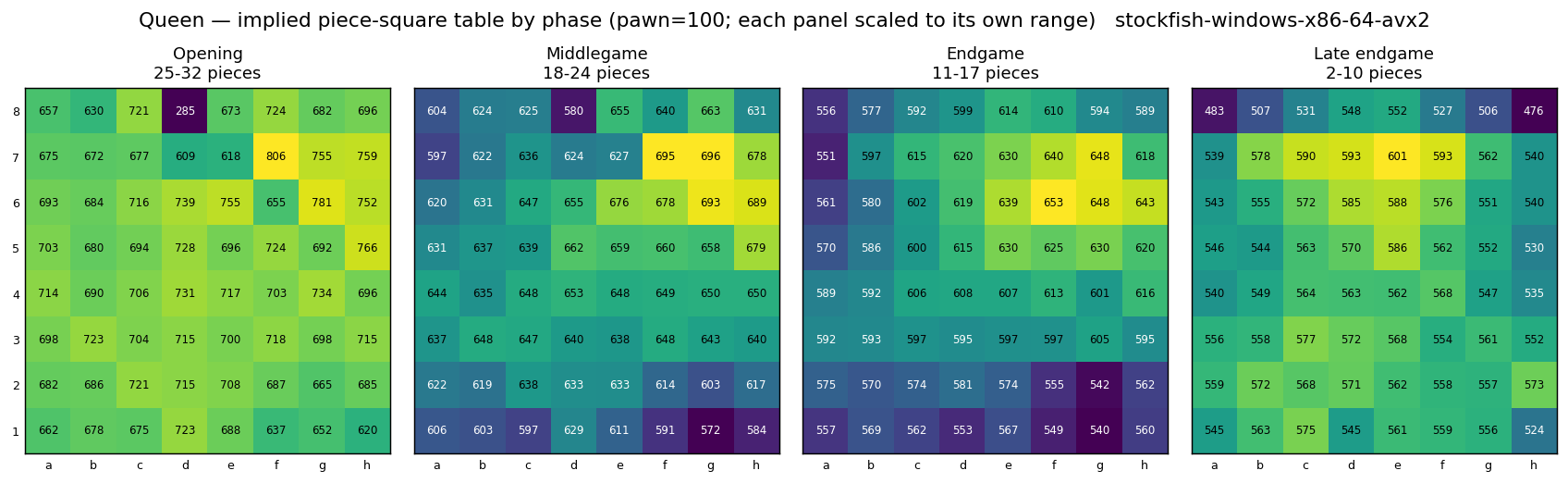
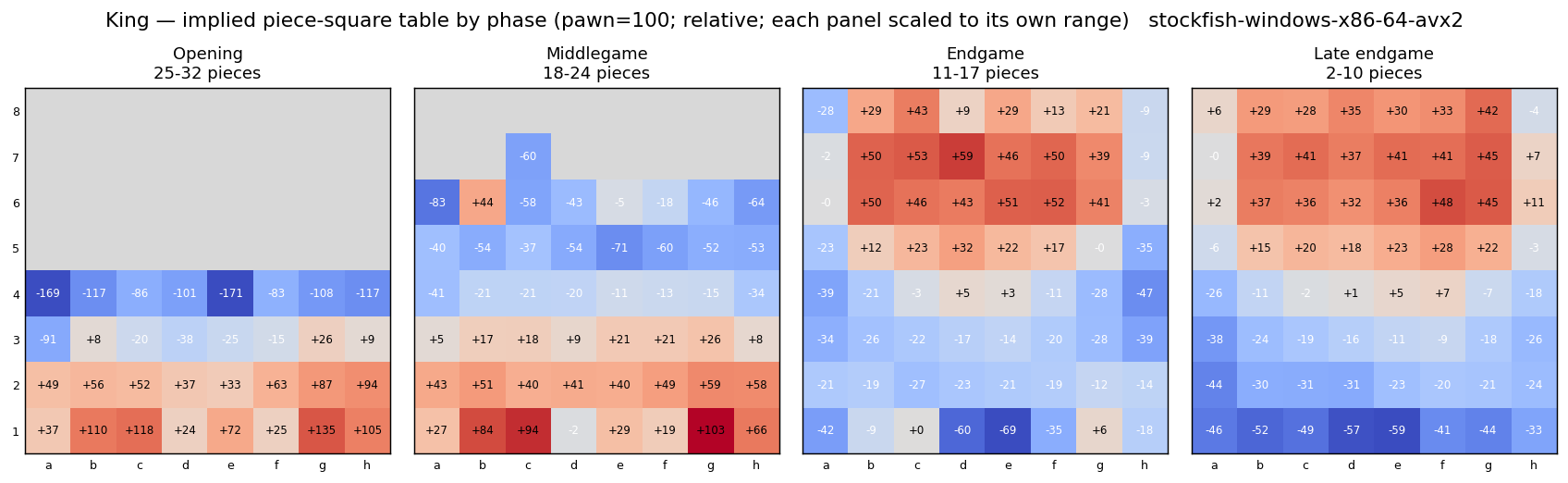
Reading them:
- Knight — loves the centre and advanced outposts, dies on the rim, and the whole map cools and flattens as the board empties.
- Bishop — prefers advanced central posts but a flatter map than the knight.
- Rook — the 7th rank lights up, plus open central files: the "pig on the 7th."
- Queen — fairly flat, with a modest advanced-central preference.
- King — the textbook reversal: safe on the castled corners in the opening/middlegame (the centre is poison), then flipping to march up and centralise in the endgame while the back rank turns toxic.
Each panel is colour-scaled to its own range, so the pattern shows at full contrast; the exact value is printed in every cell.
Pawns
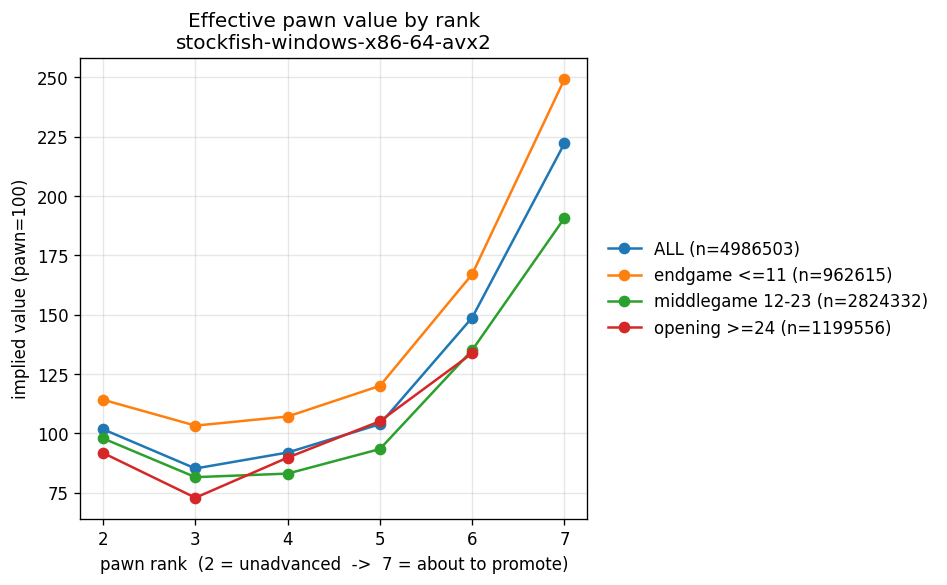
A pawn is not a pawn is not a pawn. By the rank it stands on, its value climbs from ~1.0 at home to ~2.2 on the 7th — and ~2.5 in the endgame, with a protected runner on the brink of promotion worth several pawns. Passed pawns must be pushed, recovered from nothing but games.
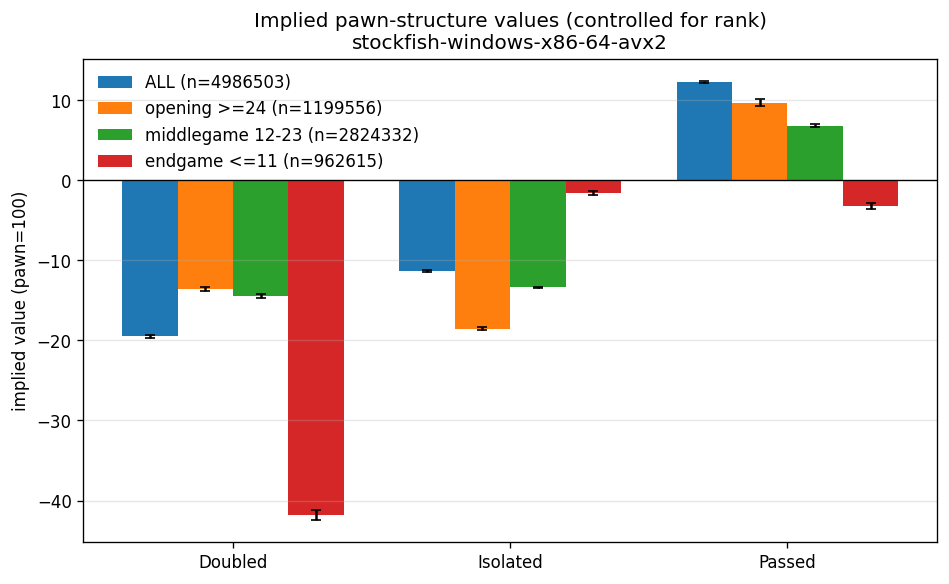
And the structure rules fall out too: doubled −0.20 (ballooning to −0.42 in the endgame, when crippled pawns can't be screened by activity), isolated −0.11, passed +0.12. Bad pawns penalised, good pawns prized — no rule was ever programmed in.
Positional instincts
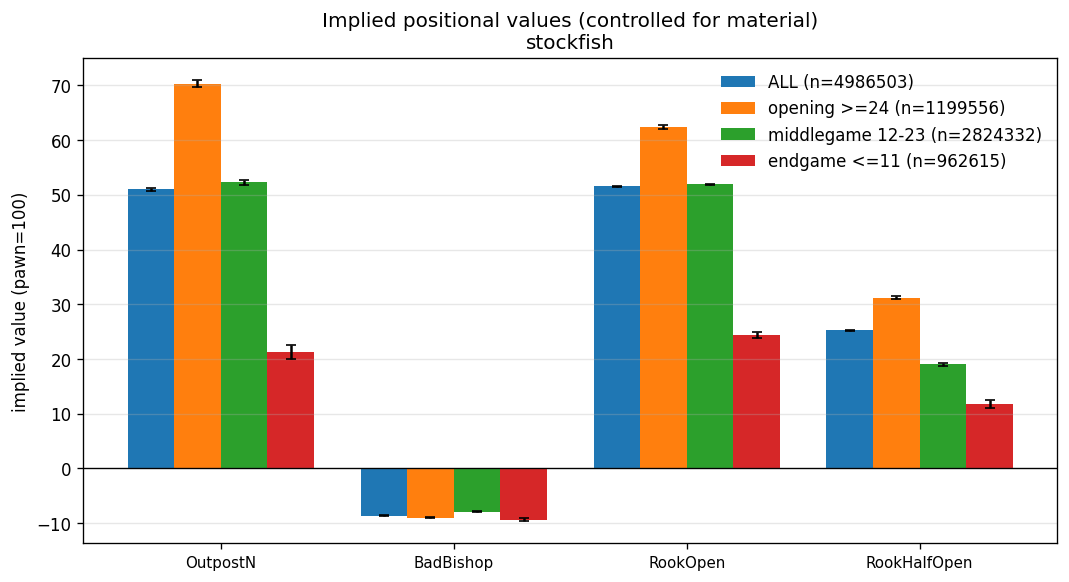
Three classic judgements every strong player makes (pawn units):
| Term | All | Opening | Endgame |
|---|---|---|---|
| Knight outpost | +0.51 | +0.70 | +0.21 |
| Bad bishop (per own-colour pawn) | −0.09 | −0.09 | −0.09 |
| Rook on an open file | +0.52 | +0.62 | +0.24 |
| Rook on a half-open file | +0.25 | +0.31 | +0.12 |
An outpost knight is worth up to ~0.7 of a pawn in the opening; a rook on an open file about the same; a bishop hemmed in by its own pawns leaks ~0.09 per blocking pawn. All peak with a full board and fade toward the endgame — the intuition, with numbers attached.
Stockfish 18 vs Chess System Tal 3 — at a glance
Both engines profiled by the same method, on the same 5-million-position set, at the same depth. All values in pawn units (pawn = 1.00). "Busy board" = 16–23 pieces; "full board" = 24–32.
Piece values
| Piece | Stockfish 18 | Chess System Tal 3 | Δ (Tal − SF) |
|---|---|---|---|
| Knight | 2.38 | 2.70 | +0.32 |
| Bishop | 2.53 | 2.85 | +0.32 |
| Bishop pair | +0.40 | +0.37 | ≈0 |
| Rook | 3.57 | 4.06 | +0.49 |
| Queen | 6.19 | 7.26 | +1.07 |
| Queen (full board) | 7.02 | 8.61 | +1.59 |
Where they agree
- The ladder. Both reproduce P < N ≈ B < R < Q, with the bishop a hair above the knight — two centuries of chess wisdom, recovered with no hand-coding.
- The bishop pair ≈ +0.4 for both, almost to the decimal.
- Knight outpost ≈ +0.5 (≈ +0.7 in the opening) for both.
- Pawn structure: doubled ≈ −0.2 (ballooning to ~−0.4 in the endgame), isolated ≈ −0.11, passers positive — same shape for both.
- Pawn advancement: a 7th-rank pawn ≈ 2.1–2.2 pawns, rising further into the endgame.
- Piece-square tables: identical patterns — knight loves the centre/outposts, rook the 7th rank, king flips from castled-safety (opening) to centralised-activity (endgame).
- Phase behaviour: every positional bonus peaks on a full board and fades as pieces come off.
Where they differ
- Tal prices every piece higher than Stockfish — and the gap widens up the ladder. Minors +0.3, rook +0.5, queen +1.1 (and +1.6 on a full board). Stockfish is the pawn-respecting valuer; Tal is piece/attack-hungry.
- Bad bishop: Stockfish penalises it harder (−0.09 per own-colour pawn vs Tal's −0.05) — SF is more sensitive to this quiet weakness.
- Rook on an open file: SF values it a touch more (+0.52 vs +0.45).
- Passed pawns: SF rewards them more overall (+0.12 vs +0.07).
- Decisiveness: Tal flagged ~5.5× as many positions as near-mate / blown-out (76k dropped vs 13k) — its evaluations swing to extremes more readily.
The standout
The two engines agree on the universal truths and disagree on the scale of force. They line up almost exactly on the things every player calls "principles" — the bishop pair, knight outposts, pawn structure, where each piece wants to stand — but diverge sharply on what a piece is worth. The single biggest gap is the queen: on a crowded board Chess System Tal values her at nearly nine pawns (8.6), versus Stockfish's seven. The engine named for chess's great romantic attacker really does put a premium on raw attacking material — heavy pieces, and the queen above all — while Stockfish banks more value in the humble, well-placed pawn.
The fine print (for the curious)
- These are tendencies, not laws. Every value here is an average over millions of real positions. On the board in front of you, a piece is worth exactly what it can do.
- The pawn is the ruler. We set the pawn to 1 and measure everything against it, which is why the bigger pieces don't land on the exact storybook numbers. The order and the way the values shift with the game are the real story.
- Two bishops, one bonus. We measure the bishop pair on its own so a single bishop's value isn't quietly inflated by it.
- Positional terms overlap with placement. An outpost knight is also a central, advanced knight, so the linear fit splits that shared credit — read each term as "extra value attributable to it," not a clean separation.
- Nothing was hand-coded. No piece values, no pawn rules, no piece-square tables were given to the method. Every number here was recovered from the engine's own play.
Built with the Engine Piece Value Profiler. Chess System Tal 3 (ep285): 4,923,988 positions. Stockfish 18: 4,986,503 positions.